Notes from a journalist on the ground in New Delhi, where heavy police deployment and detentions silenced a demonstration before it could even begin.
5:04 a.m.
I leave Malviya Nagar with colleagues in a cab. To our surprise, the driver has agreed to be paid once we have internet connection or can withdraw cash near Connaught Place. We forgot to carry enough cash, a mistake, especially today.
Delhi Police have prepared the zone thoroughly. For many kilometres there is no open shop, no food, no water, no internet and no public transport. Connaught Place, one of the busiest parts of New Delhi, is unusually quiet and empty. Shutters are down. The internet is gone.
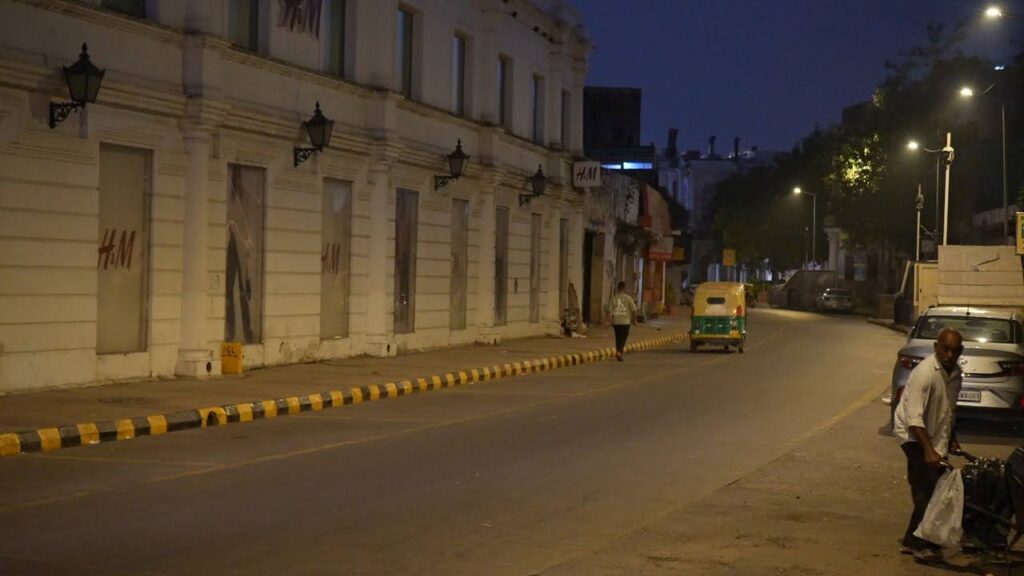
Connaught Place at 5:35 am on October 10, 2026
We find one working ATM, and only because an auto driver from Gorakhpur knows exactly where to take us. I expected both drivers to be irritated by the protest, which would disrupt their routes and work. I got the opposite. The cab driver, who is from Delhi, and the auto driver, from Uttar Pradesh, both complained about the restrictions the police had put in place. They said almost the same thing: “Ye sab toh hamare liye hi kiya jaa raha hai. Jo ho raha hai, sahi ho raha hai.” (All this is being done for us. What is happening is right.) The Protest they mean.
6:00 a.m.
Around six, the streets begin to fill, though not with protesters. A few independent journalists arrive, then more media, an ever-swelling force of police officers stationed at every corner. From their posture and body language, the police do not want anyone to feel at ease, settle in, or stand around, whether in a group or alone.
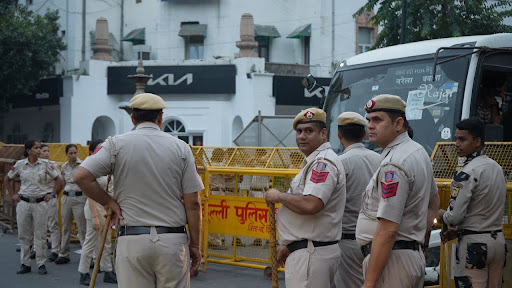
Heavy police deployment since the morning
Journalists are misdirected at first. They are told to take Baba Kharak Singh Marg to reach Patel Chowk, and those who follow the instruction are told by police there that they cannot enter from that side. They walk back toward Regal Theatre and try again. The few who manage to start their piece-to-camera [PTCs] are told to shoot from the other side of the road. The instructions are delivered with sharp hostility, as if to children being reprimanded.
Wandering away from the main site, I spot two brothers sitting on a curb, each holding a bag: Ashish Kumar, 18, and Aditya, 17. Admirers of Chandrashekhar Azad, they traveled all the way from Mubarakpur in Azamgarh district, UP—a silk-weaving hub. They tell me they arrived in Delhi on 8 October to join the protest. The reason: the names of their mother, elder sister and elder brother are missing from the voter list. They say it is the first time their family’s names have been removed, and that they have voted before. Both say they are not scared of being detained, and that protesting is their right.
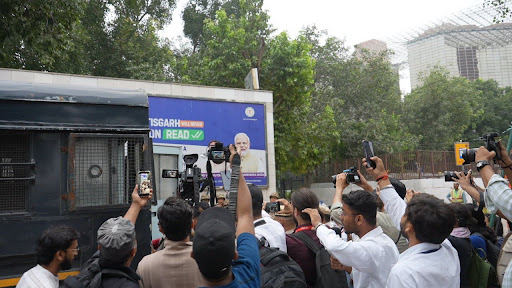
First big detention of the day at around 7:45 am near Palika Bazar Lane 2
7:45 a.m.
The area sees its first big, noisy detention. Police have found fifteen people inside a public toilet. They drag them out and push them into a blue bus with mesh windows. A shout comes from inside that someone has fainted. No one outside reacts. When the bus leaves, a police officer paces around the toilet to make sure no one else can hide there.
Behind all of this, the detentions and the YouTubers filming them, one sound has been playing since we arrived: a looped announcement, calm and mechanical.
“Citizens present here are informed that an order under Section 163 of BNSS is currently in force in this area. As per the order, gathering here, taking out a procession, blocking the road or carrying out any activity prohibited under the order is not allowed. You are requested to maintain peace and follow the directions of the police. Please do not push, break or cross the public barricade. Do not block the movement of traffic or the general public, and do not obstruct the police in the discharge of their duty.”
It plays over and over, to a street with almost no one on it.
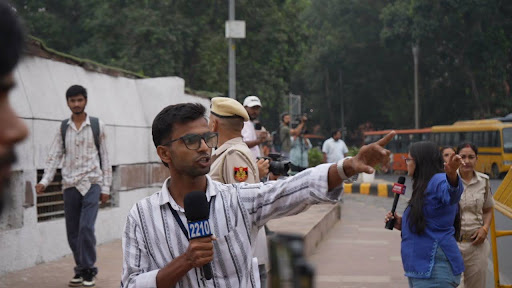
Only media and police in Central Delhi could be seen at around 8-9 am
10 a.m.
By the hour set by the Cockroach Janta Party for assembly, there are only police and media. Everyone expected the crowd to swell, and it does, but only with more reporters and more uniforms. Anyone who is suspected to be a protester is immediately detained. Press cards offer little immunity today; several journalists are hauled away alongside demonstrators.
In this sea of police and media, I manage to find a few ordinary protesters and speak to six- seven of them. They have come from Bareilly, Banda and Ambedkar Nagar in Uttar Pradesh, Sehore in Madhya Pradesh, Damodarbeda in Odisha and Deogarh in Jharkhand, with a few from Haryana and Rajasthan.
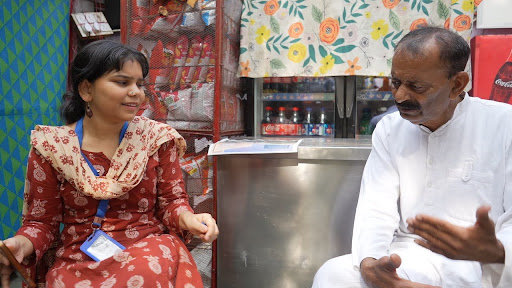
“Pichla protest mantri ke khilaaf tha is baar satta ke khilaaf hai,’ a protestor
I meet one man from Haryana at a shop, where he asks for a bottle of water and is turned away. The shop is not open, they say. I ask him about the difference between the protest, two months ago, and this one. He tells me, “Pichla wala mantri ke khilaf tha ye wala satta ke khilaaf hai.”
The shopkeeper later confides in me that the police gave him Rs 700 to keep his shutters down. He complains that protesters are ruining local business and creating a ruckus. Still, because my cameraperson and I are women, he relents after much requesting and shares his Wi-Fi password. When I ask how he has internet when it is supposed to be dead in the area, he says with great confidence, “Consider me a royal personality. If I won’t have it, who will?”
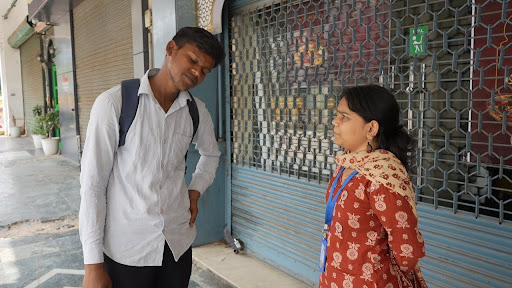
Protestor from Jaunpur whose uncle’s name was struck of the voter’s list
My focus stays on the small groups of citizens arriving from across state lines, all bound by shared grievances over the Special Intensive Revision (SIR), the government’s voter-roll exercise that stripped an estimated 13 crore citizens of their voting rights.
Compared with the protests two months ago demanding the resignation of education minister Dharmendra Pradhan, I saw fewer women at the site I was reporting from which was near Sansad Marg and Palika Bazar Lane 2. It was mostly men, apart from the media and police. They stood around, unsure what to do, because there was no crowd like last time to fold themselves into. Watching them, I felt they were more nervous than disheartened. As the day went on, videos emerged from other parts of the city showing women protesters turning up and being detained in large numbers too.
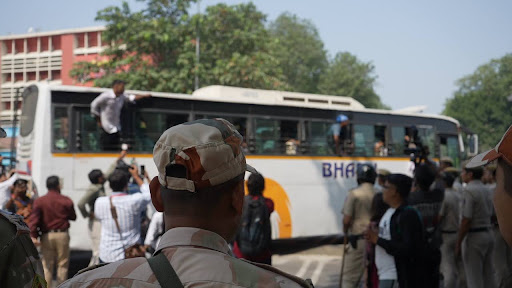
Central Delhi cleared as most people were detained by 2pm
2 pm
I leave the site. Most of the protesters have been detained, and the police have grown more hostile as the temperature climbs.
Later in the evening, I get in touch with two of the people I had spoken to, both with family members whose names had been struck off the voter list. Pappu Das from Jharkhand had been detained. Akash, 26, from Jaunpur, had not. He passed off his company ID as a press ID, and the police believed him. He reached a friend’s house in New Delhi safely, escaping a detention that many journalists with press cards could not avoid today.
Written by: Hinduja